
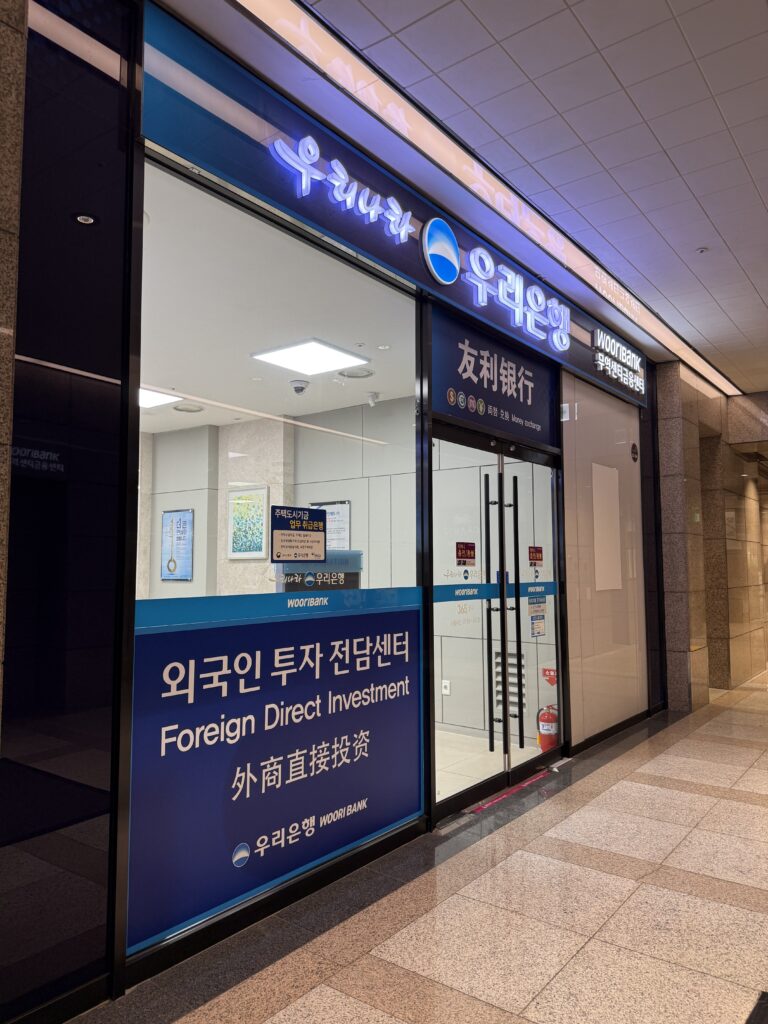
Opening a corporate bank account in Korea is one of the most important—and often underestimated—steps in launching a Korean subsidiary or foreign-invested company.
The company may already be incorporated and registered with the tax office, but that does not mean that a bank will automatically provide a fully operational account. Korean banks must conduct customer due diligence, verify the company’s beneficial owners and understand the purpose and expected pattern of its transactions. A newly established foreign-owned company may therefore face further document requests, transaction limits or additional review before it can use all banking functions.
This guide explains the practical process, the documents commonly requested and the issues foreign headquarters should resolve before attending the bank.
Key point: Company formation and bank approval are separate processes. Court registration and tax registration establish the legal entity; the bank still conducts its own KYC, anti-money-laundering and financial-transaction-purpose review.
Why Corporate Account Opening Requires Careful Preparation
Korean financial institutions apply customer due diligence when a new account is opened. The review can include the customer’s identity, beneficial ownership, purpose of the transaction and source of funds. If the bank cannot complete the required checks, it may decline to start the relationship.
For a foreign-owned company, the bank may need to trace ownership through one or more overseas parent companies until it identifies the relevant natural person or persons. Under the Korean beneficial-owner rules, the review generally begins with an individual holding at least 25% of the voting ownership and then moves through alternative control tests if that person cannot be identified.
The practical question is therefore not only whether the Korean company legally exists. The bank also needs to understand:
- who ultimately owns or controls the company;
- why the Korean entity was established;
- what products or services it will provide;
- where its operating funds will come from;
- the expected volume and countries of incoming and outgoing transfers;
- whether it has a genuine place of business and evidence of planned operations; and
- who will control the account, online banking and payment approvals.
Temporary Investment Account and Operating Account Are Different
Foreign investment funds may be remitted to a temporary account at a Korean foreign-exchange bank during the incorporation process. The remittance should be made in foreign currency and identified for the proper investment purpose.
After incorporation and tax registration, the Korean entity normally opens its corporate operating account. This is the account used for ordinary business transactions such as receiving customer payments, paying employees and vendors, settling taxes and social insurance, and managing company expenses.
The capital-remittance process and the later operating-account process should not be treated as the same bank procedure. The documents, account holder and compliance review may differ.
For an overview of the preceding legal and tax-registration steps, see our Company Establishment in Korea guide.
When Can the Corporate Account Be Opened?
The application is generally made after the Korean entity has completed both:
- corporate registration with the court; and
- business registration with the Korean tax office.
Invest KOREA describes corporate account opening at a foreign-exchange bank as a step that may proceed immediately after the required registrations. This does not, however, guarantee same-day approval or unrestricted use. The bank may need additional time to review foreign ownership, business evidence, the source of capital or the authority of the person attending the branch.
Invest KOREA also notes a 20-business-day restriction on opening an additional account at another bank. The first bank should therefore be selected with future foreign-exchange transactions, online banking, payroll payments, English-language support and approval controls in mind.
Documents Commonly Requested
There is no single document list that every bank and every branch applies in exactly the same way. Confirm the current checklist with the selected branch before the appointment.
Korean Company Documents
- recent corporate registry certificate;
- business registration certificate;
- articles of incorporation;
- certificate of corporate seal impression;
- registered corporate seal;
- shareholder register;
- foreign-invested company registration certificate, if already issued; and
- applicable licenses or permits for regulated activities.
Representative and Authorized-Person Documents
- representative director’s passport or other accepted identification;
- Korean residence card, if applicable;
- identification of the person visiting the bank;
- power of attorney and supporting corporate authorization if an agent attends;
- specimen signatures or seal documentation requested by the bank; and
- Korean contact details requested for account administration.
Foreign Parent and Beneficial-Ownership Documents
- certificate of incorporation or current registry extract of the overseas parent;
- ownership chart showing the chain from the Korean company to the ultimate natural-person owners or controllers;
- parent-company shareholder information;
- identification details for relevant beneficial owners;
- board resolution or internal authorization, where requested; and
- notarization, apostille or Korean translation where required by the bank.
Evidence of Business Purpose and Expected Transactions
- office lease agreement;
- business plan or concise description of Korean operations;
- customer or vendor contracts, purchase orders or invoices;
- evidence of employees, payroll or planned recruitment;
- website, product materials or required operating licenses;
- expected monthly transaction volume and average transaction size;
- expected countries and counterparties for overseas remittances; and
- documents explaining the source and intended use of funds.
Banks may request only part of this list or may ask for additional items. Complex ownership, higher-risk jurisdictions, regulated activities, frequent overseas transfers or limited operating evidence can lead to enhanced review.
Can an Agent Open the Account Under a Power of Attorney?
Sometimes—but it should never be assumed.
Invest KOREA’s published checklist recognizes applications made through an agent and refers to the agent’s identification. In practice, however, the selected bank or branch may still require additional authorization documents, direct confirmation with the representative director or a personal visit, particularly where foreign ownership or account-control arrangements require further verification.
Before relying on a power of attorney, obtain advance confirmation from the actual branch that will process the application. A power of attorney can establish authority, but it does not override the bank’s own KYC or risk-review requirements.
The Transaction-Limit Account Problem
Even when a bank opens the account, it may initially apply transaction limits if the company cannot yet provide sufficient objective evidence of its financial-transaction purpose.
The Financial Services Commission explains that transaction-limit accounts are used where the necessary evidence is insufficient. Since May 2024, the standard daily limits at commercial banks have generally been:
- KRW 1 million through internet or mobile banking;
- KRW 1 million through an ATM; and
- KRW 3 million at a bank counter.
These limits can make a newly formed company’s account impractical for payroll, rent, taxes or vendor payments. The company should therefore ask the branch, before opening the account:
- whether the account will initially be transaction-limited;
- which documents will be accepted to remove the limit;
- whether contracts, tax invoices, VAT certificates, financial statements or the office lease will be required; and
- how long the branch expects to review the limit-removal request.
The Financial Services Commission also notes that banks may request additional evidence and that required documents can differ by bank. Submission of documents does not automatically guarantee immediate removal of the limit.
Do Not Stop at the Account Number
An account number alone does not complete the banking setup. Foreign headquarters should confirm the operational requirements needed to use the account every month.
These may include:
- corporate internet-banking enrollment;
- OTP or other security device issuance;
- transfer limits appropriate for payroll and taxes;
- single- or multi-level payment approvals;
- designated administrators and authorized users;
- overseas-remittance permissions and supporting-document procedures;
- foreign-exchange reporting or designated-bank arrangements;
- corporate debit or credit cards; and
- bank-statement and transaction-data formats needed by headquarters or the accounting team.
These settings matter especially when the Korean company has no local finance employee. A foreign headquarters may discover too late that the person holding the OTP is unavailable, the online transfer ceiling is too low or the bank requires fresh supporting documents for a cross-border payment.
Common Causes of Delay
Corporate account applications often slow down because of practical gaps rather than a single missing statutory form. Common examples include:
- an ownership chart that stops at an overseas holding company rather than identifying the relevant natural-person owners or controllers;
- inconsistent descriptions of the business across the articles, business registration and bank application;
- a representative director or agent attending without bank-approved authority documents;
- limited evidence of actual or planned Korean operations;
- overseas documents that require translation, notarization or apostille;
- unexplained capital flows or expected transfers involving multiple jurisdictions;
- a virtual or shared-office arrangement that requires further explanation; and
- failure to plan internet banking, OTP custody and internal payment approvals in advance.
The best approach is to provide one coherent explanation connecting ownership, business purpose, funding, expected transactions and account control.
Practical Checklist Before Visiting the Bank
- Select the bank and branch before finalizing the appointment.
- Obtain the branch’s current checklist in writing where possible.
- Confirm whether the representative director must attend personally.
- If an agent will attend, have the branch approve the proposed power-of-attorney format in advance.
- Prepare a clear ownership chart through to the relevant natural persons.
- Align the business description with the articles and business registration.
- Bring objective evidence of expected Korean operations and transactions.
- Ask whether the account will be subject to transaction limits.
- Confirm the documents needed to remove any limit.
- Decide who will hold the OTP and administer online banking.
- Set transfer and approval limits suitable for payroll, taxes and vendors.
- Plan how overseas remittances and supporting documents will be handled.
How Korean Tax Expert Can Assist
Korean Tax Expert supports foreign companies with the administrative and operational work surrounding corporate banking, including:
- coordinating with the selected Korean bank or branch;
- preparing and reviewing the corporate document package;
- organizing beneficial-ownership and foreign-parent information;
- explaining the company’s expected payroll, tax and vendor-payment flows;
- supporting online-banking and payment-process setup; and
- coordinating ongoing payroll-related funding and approved payments where separately agreed.
We provide administrative, accounting and banking-coordination support. We are not a bank and cannot guarantee account opening, unrestricted account status, transfer limits or approval of any banking service. The bank makes the final decision under applicable law and its internal KYC and risk policies.
If you are establishing a Korean company or are having difficulty completing its banking setup, contact our English-speaking team with a brief description of the ownership structure, business activity, representative director and expected transactions.
Frequently Asked Questions
Can a newly incorporated foreign-owned company open an account immediately?
It can generally apply after corporate and business registration. Actual activation, transaction limits and online-banking functions remain subject to the bank’s review.
Must the foreign representative director visit Korea?
Not in every case, but a remote or agent-led opening should not be presumed. Acceptance of a power of attorney and the required verification steps vary by bank, branch and risk assessment.
Is a Korean office lease enough to prove the transaction purpose?
It can be useful evidence, but the bank may also ask for contracts, invoices, licenses, employment plans, tax documents or other proof of real business activity.
Can the company use an overseas parent-company account instead?
An overseas account does not provide the same practical functionality as a Korean corporate account for ordinary domestic payroll, taxes, social insurance, customer receipts and vendor payments.
How long does corporate account opening take?
There is no reliable universal timetable. A straightforward application may be handled quickly, while foreign ownership, complex UBO structures, missing documents or enhanced due diligence can extend the process.
Official References
- Incorporation Procedure and Corporate Account Requirements — Invest KOREA
- Customer Due Diligence Regime — Korea Financial Intelligence Unit
- Act on Reporting and Using Specified Financial Transaction Information — Korean Law Information Center
- Transaction-Limit Account Guidance — Financial Services Commission
This article provides general information and does not constitute legal, tax or banking advice. Required documents, attendance rules, approval timing, account limits and available services may differ by bank, branch, ownership structure, transaction profile and the bank’s internal compliance assessment.
